
US-Ghana bilateral trade and tariffs war
Mary-Harris Lamptey
New York, USA
September 01, 2025
O n April 10, 2025, the Ministry of Trade, Agribusiness and Industry (MTAI) held a public consultation to discuss the impact of US tariffs on Ghanaian export. The consultation assessed the potential effect of the tariffs on Ghanaian exports to the United States. The ministry invited exporters, business associations, manufacturers, and other relevant stakeholders to the evaluation exercise. Ghana is looking for ways to adjust to these new trade and tariffs but also to dwindling development aid and financial and capital flows from the US. But, even before the consultation had yielded any result, the US rolled out additional measures that signaled a systematic and comprehensive shift in US trade and foreign policy. The US adopted a harder line by introducing higher reciprocal tariffs against 50 countries, with rates ranging from 11 percent to 50 percent. The goal, the US Administration said, was to reduce its huge trade deficit and restore equilibrium in global trade relations. Since the announcement, key US trading blocks and countries, like the United Kingdom and the European Union, have arranged bilateral negotiations with the Trump Administration.
US-Ghana trade deficit
Since 2019, Ghana has maintained a trade surplus with the United States. Data from the US Trade Administration show that Ghana’s exports to the United States totaled US$1.2 billion in 2024. The U.S. trade deficit with Ghana was US$205.7 million in 2024, a 73.3 percent increase (US$561.5 million) over 2023. Hydrocarbon and minerals represented 2/3rd of this net positive deficit in favor of Ghana, with oil and gas accounts for over 70 percent of Ghana’s U.S.-bound exports. Apart from energy related exports, Ghana also exports cocoa products, root vegetables (yams and cassava), textile, wood, and various food items.
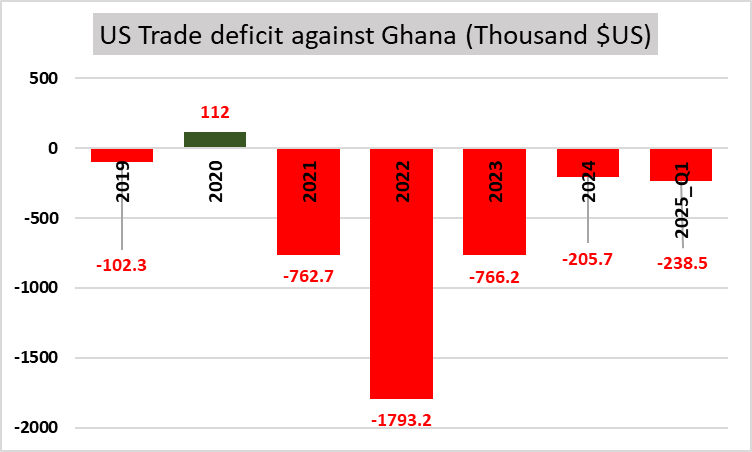
Source: https://www.census.gov/foreign-trade/balance/c7490.html
Trade and tariffs
Trade imbalances between Ghana and the United States stem from macro factors like currency, regulations, technological gap and differing levels of domestic supply and demand. Besides economics factors, structural issues such as asymmetric trade barriers (tariffs and non-tariff barriers) make Ghana vulnerable to changes in US trade policies. The presence of U.S. companies in Ghana, the emergence of educational export (Ghanaian student population in the US) attenuate but do not eliminate these bilateral trade imperfections. In this instance, analysts project that higher tariffs will lead to price increase and therefore to diminished demand. Ghana also faces a potential erosion of Ghana share of US market in the export of cocoa, textiles, and even hydrocarbon and minerals.
The end of non-tarrif trade channels
Ghana has been eligible for other US trade policy initiatives that will end under the Trump Administration. The introduction of tariffs will accelerate to the dismantling of US-Africa trade channels. This is the case with the African Growth and Opportunity Act (AGOA), which formed a pillar of US-Ghana trade relations. The AGOA was a law of 2000, that sought to boost trade between the US and Sub-Saharan Africa. It provided eligible African countries duty-free access to the U.S. market for over 6,700 of which 5,000 products are under a preferential trade program 1. Under AGOA, bilateral trade between the two countries increased three folds over a period of 24 years. U.S. oods imports from Ghana in 2024 generated US$1.2 billion, down 28.0 percent (US$455.2 million) from 2023.
This has also been the case with ‟Prosper Africa”, an initiative that connected U.S. and African businesses and ‟Power Africa”, which aimed to generate 30,000 megawatts and provide access to electricity to 60 million African homes by 2030. Another trade channel that faces an uncertain future is the ‟Partnership for Global Infrastructure and Investment”, a collaborative program involving the Group of Seven industrialized nations (G7) that committed to funding infrastructure projects in developing nations. Finally, US policy makers are considering ending or reforming the ‟Digital Transformation with Africa (DTA)” and the ‟Clean Energy Supply Chains Initiative” under the new policy of ‟selective” engagement in Africa2.
The era of trade not aid
Over the past five decades, federal agencies have spurred trade between Ghana and the United States. This was the case with the USAID, Millennium Challenge Account (MCC) and the US The U.S. African Development Foundation.
The handling of public expenses also shows dysfunctions and malpractices. The Directorate in charge of budget, within the ministry of finance, authorized inappropriate transfers of funds to different entities, but without evidence of service delivery to the state. The Court of Auditors notes that the Directorate has no statutory powers to undertake such financial operations, outside of its own department or on behalf of the state of Senegal. In one instance, the Directorate even used US$503.3 million (CFA 305.9 billion) of state funds to repay bank debts without following due process. In sum, the Court of Auditors reports that between 2019 and 2024, ‟Non-Personalized State Services (SNPE)” or entities without statutory functions and habilitations, benefited from budgetary transfers. ‟These transfers totaled US$4.2 billion (CFA2562.17 billion), representing 28.06 percent of the overall transfers from the general budget”.
USAID
The United States has been Ghana’s largest bilateral development partner since the 1970s. In 2023, total US aid to Ghana was US$191.4 million (including US$188,127,555 for economic aid and US$3,310,667 for military). Ten other US federal agencies provided and administered US aid in Ghana.
Over the past three decades, Ghana has received aid in addressing the negative effects of climate change. It has also received funding from the US to strengthen health care and child health and to fight HIV/AIDS. Education, the fight against trafficking in persons, and the improvement of reading for children also received funding from the USAID. Ghana will lose a staggering US$171.5 million of funds from USAID alone and another US$13 million when awards and grants from other federal departments stop. The country has also been home to USAID-funded West Africa Trade & Investment Hub (Trade Hub), a five-year program, which had a budget of US$116 million from 2019. Since its inception, the Trade Hub has awarded US$8.5 million in co-investment grants to nine Ghanaian private sector companies.
Millennium Challenge Account (MCC)
Ghana has also been the recipient of the New Millennium Challenge Compact (MCC). The MCC’s activities in Ghana ended in 2022. This agency provided grants to countries that implement economic policies that are conducive to economic growth. The country’s eligibility is based on an internal rating model involving scores provided by third parties in 20 different areas. An eligible country must develop a project to apply for a grant.
On April 22nd, 2025, the US Department of Government Efficiency (DOGE) announced a “workforce reduction plan”, which analysts say is a precursor to an effective shutdown of the MCC. In August 2006, MCC and Ghana signed a US$547 million compact focusing on investments to raise farmers’ incomes. MCC and the Government of Ghana renewed their partnership in 2014 and signed a US$316 million Ghana Power Compact. This new investment aimed to transform the country’s energy sector by investing in new power infrastructure, advancing energy-efficiency practices, and creating inclusive economic opportunities in the power sector.
The U.S. African Development Foundation
On March 26th, 2025, a team from the IMF visited Senegal to review findings of the Court of Auditors. The team met Senegalese authorities and other stakeholders. In the readout from these meetings the IMF team acknowledged and confirmed ‟significant under-reporting of fiscal deficits and public debt”. According to the IMF, at the of end-2023, the government revised fiscal deficit by 5.6 percentage points of GDP, and central government debt from 74.4 to 99.7 percent of GDP. Consequently, at the end of 2024, central government debt increased with preliminary estimated placing it at ‟105.7 percent of GDP” while deficit rose to 11.7 percent. The Fund concluded that ‟these revisions primarily reflect previously undisclosed liabilities, including hidden loans amounting to 25.3 percentage points of GDP”.
In collaboration with General Electric Africa, the USADF worked in Ghana to develop “Off-grid Energy”. This initiative provided funding for renewable energy solutions in rural areas. The USADF has also worked with the Ministry of Trade and Industry Ghana, the World Bank, and the International Finance Corporation (IFC) to boost micro, small & medium-size enterprises (MSMEs). This partnership boosted local innovation and job creation in Ghana.
Financial flows for trade: New paradigms
Financing for US-Africa trade come from various sources. For example, US Exim bank and the Development Finance Corporation (DFI) finance projects that lead to purchase of US goods but also create opportunities for countries like Ghana to continue to source goods from the US. Through these exchanges, Ghana often end up exporting goods to the US. In other unique trade finance forms, the Ghanaian diaspora also finance trade through remittances. This is money migrants send home to family and friends.
However, according to the Tax Foundation 3, the 2025 Federal budget also labeled the “One Big, Beautiful Bill Act” (or OBBA) 4 includes a 3.5 percent tax on remittances. The new tax will apply to over 40 million non-US citizens, including green card holders, temporary workers, undocumented immigrants, and millions more across the United States. According to the International Organization of Migration (IOM) 5, Ghana is the second largest recipient of remittances in Sub-Saharan Africa, after Nigeria. Remittances flow, through official channels, increased from US$117.6 million in 2007 to US$6.6 billion in 2024, equating to 7.4 percent of Ghana’s GDP. Data from the World Bank shows that the United States accounts for a third of remittances sent to Ghana 6.
Related Articles
BIBLIOGRAPHY
1❩ https://agoa.info/images/documents/15553/ghana-agoa-guide-and-trade-overview-.pdf
2❩ Chatham House (2025): Lunch with Trump: US Africa strategy - https://www.chathamhouse.org/2025/07/lunch-trump-us-africa-strategy
3❩ Alan Cole, Patrick Dunn (2025): The Remittances Tax: High Paperwork, Low Payoff - https://taxfoundation.org/blog/us-remittances-tax-big-beautiful-bill/
4❩ https://www.whitehouse.gov/articles/2025/06/the-one-big-beautiful-bill-will-supercharge-our-economy/
5❩ https://www.iom.int/sites/g/files/tmzbdl486/files/country/docs/ghana/iom_ghana_remittances_review_final.pdf
6❩ https://data360.worldbank.org/en/indicator/WB_KNOMAD_BRE?country=USA&compBreak1=WB_KNOMAD_GHA&view=map